
What thread broke first: the knowledge or the chain?
Textile: between lost craft and scalable technology
The chain broke. Offshored, forgotten, dissolved into global supply lines where the cheapest kilometer of fabric wins. What remains locally is disconnected: knowledge that disappeared from living memory, a 60kg bale of raw flax with nowhere to spin, and a family firm that has stayed rooted in Heeze for 125 years by constantly asking how to make textile matter here, still.
Now two people are trying to repair that chain. From opposite ends.
At this edition of the EHV Innovation Cafe, join Linde van Vlijmen and Marc Evers to explore what it takes to rebuild a textile chain that actually regenerates, and whether that future begins with a seed or a patent.
Featuring
Linde van Vlijmen (Back to the Flax / Design Academy Eindhoven)
Going back to the field: hand-processing flax, mapping what was lost, designing the system around the material rather than the material itself.
Marc Evers (EE Labels / EE Exclusives)
Staying in the industry: partnering with deep-tech companies that turn cotton waste into premium lyocell fiber or turn polyester into new polyester, at scale, with 50% lower carbon.
Both believe the textile industry can regenerate. But they are not starting from the same place, working at the same scale, or asking the same questions.
That is exactly the conversation we want to have.
Because at the EHV Innovation Cafe, the discussion is not the afterthought. It is the main act.
We are Inclusive by Default and Give to Grow.
What thread broke first: the knowledge or the chain?
@ Kazerne Downtown Eindhoven
Walk in 17:30, Start 18:00
English spoken, Free entrance, Open to All


Speakers
Linde van Vlijmen
Social Material Designer / Member of the Back to the Flax Collective
Superpower
Designing the system, not the object: mapping the relationships between people, materials and the chains that connect them.
Bio
Linde van Vlijmen is a bachelor student at the Design Academy Eindhoven who describes herself as a social material designer. With a background in Organisational Psychology and Organisation Anthropology, she brings a rare double lens to design: understanding how people relate to themselves, each other and the world, and how those relationships are shaped by culture, social structures and economics.
Her practice combines hands-on experimentation with bio-based materials and the mapping of production systems. Rather than designing fixed outcomes, she focuses on transformation: what can a material become next, and how does it exist within a regenerative society? This moves her practice from making objects to designing the systems around them.
Since 2024, Linde has been a member of the Back to the Flax collective, hand-processing flax on a 1,000 square meter field in Gijzenrooi and confronting the gap that followed: no Dutch spinning infrastructure left to process what they grew.
She also runs Gaatjesmakers, offering Visible Mending workshops as both a practical skill and a social bridge: making repair visible rather than hidden, and bringing together strangers who would not otherwise share a table.
Statement
“I believe that regenerative futures depend on healthy systems: social, ecological, economic and political. Healthy systems are built on strong, diverse relationships. What creates, maintains or transforms those relationships is what I seek to understand.”
Marc Evers
Director and Owner of EE Labels and EE Exclusives
Superpower
Keeping textile alive in the region across five generations, by always asking what responsibility means at scale.
Bio
Marc Evers is the fourth-generation director and owner of Van Engelen and Evers, the family firm behind EE Labels and EE Exclusives. Founded in Heeze in 1900, the company has operated its own weaving facilities for over 125 years, producing labels, hangtags and jacquard fabrics for clients worldwide, including Viktor and Rolf, Hella Jongerius and the Dutch royal court. Today Marc runs the company together with the fifth generation: his son and daughter.
For Marc, sustainability is not a certificate. It is a long-term orientation: maintaining production in the Netherlands and Turkey, and partnering with the technologies that make textile genuinely circular. SaXcell transforms cotton-rich textile waste into premium lyocell fiber with no virgin resources and 99% solvent recovery. Reju guarantees old polyester becomes new polyester, with almost 50% less carbon than virgin production.
His conviction: the technology exists. What is needed now is the will and collaboration to bring it to scale, because sustainability that stays niche stays symbolic.
Statement
“Sustainable textile only contributes to a better world if it works at scale. That is what gives me hope: the technologies are there. Now we need to build the will to use them.”

The Eindhoven region once made textile. Then the chain broke. Offshored, forgotten, dissolved into global supply lines where the cheapest kilometer of fabric wins. What remains locally is disconnected: knowledge that disappeared from living memory, a 60kg bale of raw flax with nowhere to spin, and a family firm that has stayed rooted in Heeze for 125 years by constantly asking how to make textile matter here, still.
Now two people are trying to repair that chain. From opposite ends.
One goes back to the field, hand-processing flax, mapping what was lost, designing the system around the material rather than designing the material itself. The other partners with deep-tech companies that turn cotton waste into premium lyocell fiber and guarantee that old polyester becomes new polyester, at industrial scale, with 50% lower carbon.
Both believe the textile industry can regenerate. But they are not starting from the same place, working at the same scale, or asking the same questions.
That is exactly the conversation we want to have.
Does a regenerative textile future begin with a seed or with a patent? With recovering lost knowledge or with investing in new technology? With one repaired garment on a table shared with strangers, or with a production line that processes thousands of tonnes of waste? And what happens when these two approaches meet: do they reinforce each other or expose each other’s limits?
The chain is broken. Something new is being built. But by whom, at what scale, and in whose interest?
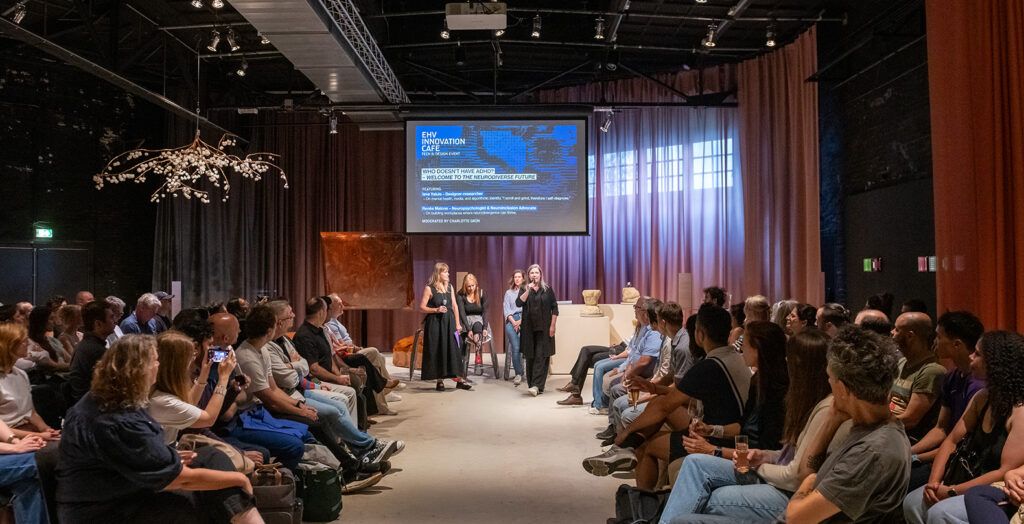
Our city is full of hidden Tech & Design gems that fuel transformation. Now is the time to unite their superpowers. What visions do they hold for creating an attractive, sustainable world for us and future generations? What groundbreaking experiments and prototypes are they developing to boost our society forward? How can we learn from each other and contribute to this shared mission? Join us for an inspiring event where ideas and connections come to life!
Join the EHV Innovation Café Tech & Design Meetup
Do you want be a part of the Future of Eindhoven? Mark the event in your calendar and secure your free ticket here. Walk in is also possible but the seats for the debat are limited. Don’t miss out on this opportunity!
28 May 2026
17:30 Walk-in and networking, we’ll offer a free drink and a bite
18:00 Introduction to the Special Guests followed by a moderated debate
19:00 Networking
20:00 Meet-up dinner with the speakers
English spoken, of course