
Consent, Compost and Community
The future is already lived in. Someone already went live.
We keep designing and developing for the future as if it doesn’t exist yet. Klein Oers proves it does: 40 households in Veldhoven, living on consent, compost toilets and shared heat pumps. Rewild Farming proves it too: a once-neglected urban plot in Eindhoven, regenerated from the ground up by people who had never farmed before.
Join us to explore what it means to redesign how we live, eat and decide together.
High tech where it helps. Low tech where it works. Not in a roadmap. In practice, right now, in this region.
Featuring
Carolien Weerstand — artist-designer, Studio Weerstand / Resident Klein Oers
Exploring alternatives to linear production through craft, old knowledge and new technology.
Cynthia van Schendel — founder, Klein Oers / integrative health scientist
Health scientist who extended the meaning of health to ecosystems and communities.
Bram de Vos — designer and co-founder, Rewild Farming
Turning regenerative farming into something young people actually want to do outdoors.
(Bram also presents the work of Benjamin Onno Dikmans, co-founder of Rewild Farming, who’s work is part of the Kazerne Design Award nominee exhibition at Kazerne til the end of September)
Between them, they offer proof of living: not a concept, not a pilot program, but working evidence that a different way of organising life is already here, already occupied, already growing.
The real question is not whether these models work. It is whether we are ready to decide together.
That is exactly the conversation we want to have. Because at the EHV Innovation Café, the discussion is not the afterthought. It is the main act. We are Inclusive by Default and Give to Grow.
Moderated by Charlotte Grün
Walk in from 17:30, event starts at 18:00.
@ Kazerne Downtown Eindhoven – English spoken, Free entrance, Open to All.


Speakers
Carolien (Caro) Weerstand
Making circular production tangible, beautiful and actually liveable.
Carolien Weerstand works between art and design at Studio Weerstand, investigating alternatives to linear production processes. She believes that the solutions of the future do not always need to be more complex or more technological. They can emerge from a smart combination of old knowledge, hands-on craft and new technology. For the past 18 months, she has tested that belief from the inside: as a resident of Klein Oers eco-village in Veldhoven, where the materials she studies are also the walls she lives within.
“The solutions of the future might be simpler than we think. And older.”
Cynthia van Schendel
Building communities that protect not just human health, but the health of all life on Earth.
Cynthia van Schendel is an integrative health scientist (MBOG specialist) and the founder of Klein Oers. Her mission is to extend the meaning of health beyond the individual to include ecosystems, communities and the living world. The eco-village she initiated, 40 households organized around consent, sustainability and shared responsibility, is not a concept for that vision. It is the proof of living.
“Health is not a personal achievement. It is a shared condition.”
Bram de Vos
Turning regenerative farming into something young people want to do.
Bram de Vos is a designer whose work sits at the intersection of landscape, food systems and social infrastructure. He graduated from Design Academy Eindhoven and in 2020 presented his graduation project Uprooting Agro Systems at Kazerne: a proposal for making cities food-resilient through a deliberate combination of vertical farming, food forests and syntropic agriculture. That project established the core conviction of his design studio: that the most pressing design challenges in our cities are not about aesthetics or efficiency, but about rethinking the systems that sustain us.
Together with Benjamin Onno Dikmans, whose Rewild Farming Starter Kit was nominated for the Kazerne Design Award, he co-founded Rewild Farming: a practice that brings regenerative agriculture back to the urban edge through starter kits, community stewardship and a shared knowledge network developed with TU/e and FABLab BCN. Their pilot De Fuuttuin, on Eindhoven’s Fuutlaan, has turned a once-neglected urban plot into one of the city’s most active regenerative food communities, and achieved what traditional ecology programmes rarely manage: drawing a young audience between 20 and 40 into hands-on land stewardship. During this event, Bram presents their shared work; Benjamin is abroad.
“You only care about land you have worked with your own hands.”

We like to imagine the future as something we are still building toward. A more sustainable neighbourhood. A better food system. A community that actually functions. But what happens when the future is already lived in?
Klein Oers is a 40-household eco-village in Veldhoven. Its residents share heat pumps, solar panels and heat recovery systems. They also use compost toilets, a permaculture garden, and an underground grey water filter that feeds into a plant channel and two wadi ponds. The dorpshuis, now under construction, serves as a living lab for bio-based and recycle-based materials: mycelium panels, algae plaster, recycled PVC, rejected sheep’s wool. None of these are finished products. All of them are being tested in actual daily use.
Governance runs on sociocracy and the Consent method. Not everyone needs to agree. But no one can block without a fundamental objection. It is an ancient principle, applied at neighbourhood scale, and it turns out to be one of the most consequential design decisions the community has made.
Rewild Farming begins differently: with a repurposed shipping container on a neglected urban plot. The container is not infrastructure; it is a starter kit for regenerative agriculture, equipped with workbenches, kitchen, storage and adaptable scaffolding. The method is designed to replicate: multiple containers, multiple locations, one shared knowledge network built with TU/e and FABLab BCN. At De Fuuttuin on Eindhoven’s Fuutlaan, Bram de Vos and Benjamin Onno Dikmans have achieved something that ecology and biodiversity groups rarely manage: a regenerative practice that young city-dwellers between 20 and 40 actually show up for, and come back to.
Neither initiative invented something new. Permaculture, syntropic farming, sociocracy, grey water filtration: these methods are old, tested and, for various reasons, out of fashion. What is new is the context, the urgency, and the people choosing to use them right now, in Brainport, in 2026.
For Kazerne Designlab, where nature-inclusive thinking is not a theme but a condition of practice, this conversation is long overdue. Design and technology do not always supply new answers. Sometimes they are the translation layer that makes old answers finally liveable, at scale, for a new generation.
Because at the EHV Innovation Café, the discussion is not the afterthought. It is the main act.
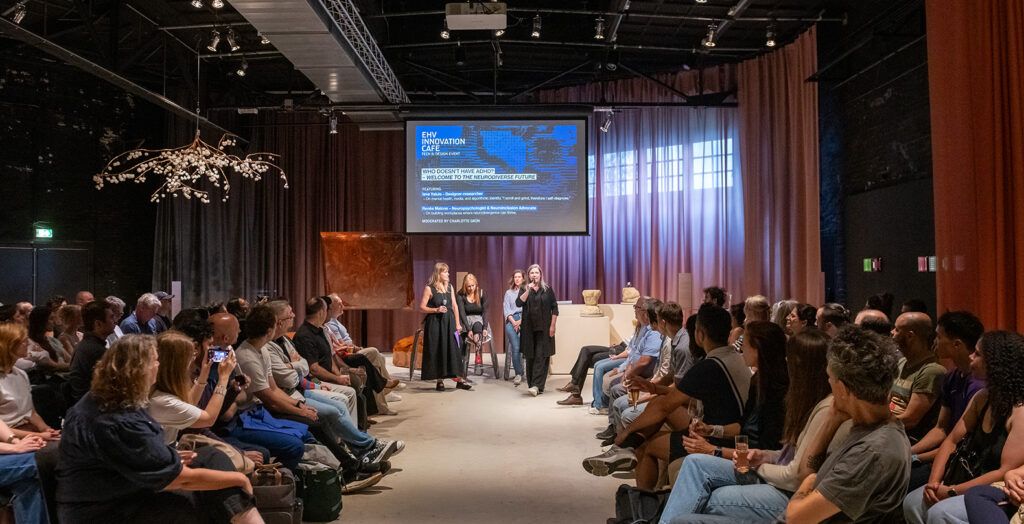
Our city is full of hidden Tech & Design gems that fuel transformation. Now is the time to unite their superpowers. What visions do they hold for creating an attractive, sustainable world for us and future generations? What groundbreaking experiments and prototypes are they developing to boost our society forward? How can we learn from each other and contribute to this shared mission? Join us for an inspiring event where ideas and connections come to life!
Join the EHV Innovation Café Tech & Design Meetup
Do you want be a part of the Future of Eindhoven? Mark the event in your calendar and secure your free ticket here. Walk in is also possible but the seats for the debat are limited. Don’t miss out on this opportunity!
27 August 2026
17:30 Walk-in and networking, we’ll offer a free drink and a bite
18:00 Introduction to the Special Guests followed by a moderated debate
19:00 Networking
20:00 Meet-up dinner with the speakers
English spoken, of course